
What is Black August? Imagine a flower bouquet which holds a bunch of beautiful flowers. August is like the thread that connects the flowers. Separate events in separate years took place under different circumstances. Black August asks us to look at the thread connecting them. That thread is resistance, what connects the incidents. Was that resistance so simple?
Are the people remembered during August all the same? No, they are not. And they didn’t use the same methods to show their position against what they believed was injustice. You see the 17-year-old young man in a California courtroom in 1970. You see his older brother inside San Quentin Prison a year later. Remember the people who gathered in Washington in 1963.
Some of them believed in nonviolent protest. Some believed in political organising. Some called for self-defence. Others embraced revolutionary ideas. Some were celebrated as heroes. Others were condemned as convicts or dangerous radicals. Maybe that’s why we need to understand Black August observance beyond celebrating. Black August asks us to remember them and to understand what made them resist.
What Is Black August?
Do you want to connect with Black history in August? First, you need to understand what Black Americans were struggling against. August is a month of political education and remembrance. A month that connects generations of Black resistance. Black activists incarcerated in California prisons in the late 1970s started the tradition. In August, they remembered people who had died. Or been imprisoned during struggles for Black liberation and political change.
But Black August connected to a much wider history over time. It includes resistance against slavery, colonialism, and racial discrimination. It also connects to police brutality, political repression and unjust imprisonment. Remembering August is not similar to a celebration like Black History Month. Instead, it deeply connects to radical Black political movements. And prison activism and the idea of liberation. Traditionally, this month encourages study, self-discipline, fasting, and physical training. This also includes political education, alongside remembrance.
A Long History of a Fight for Freedom and Equality
Is the history of Black Americans only a history of suffering? No, it is also a history of survival, achievement, creativity and resistance. But why did they have to struggle for equality that continues? Black people in America lived under slavery for generations. Even after the abolition of slavery in America, they didn’t get true freedom. The freedom that ensures equal citizenship, safety and opportunities.
They faced century-long segregation, racial violence, and discrimination in housing and employment. Unequal education and treatment within parts of the criminal justice system continued to shape Black lives. So they have fought for equality against discrimination. But different generations responded differently to the call for resistance.
Some worked within political institutions. Some challenged discriminatory laws in court. Some organised peaceful demonstrations. Some promoted economic independence and Black self-determination. Others came to believe that the American system itself needed fundamental change. So, it is impossible to describe “the Black struggle” as one single movement. Historical Black leaders struggled from different stands. But they had a common goal─ ensuring Black rights.
August 1791: When Enslaved People Rose for Freedom
Enslaved people in the French colony of Saint-Domingue began an uprising in August 1791. This is one of the earliest events that connected to August. It took place outside the United States. That eventually contributed to the creation of the world’s first independent Black republic, Haiti.
Enslaved people had been denied freedom over their own lives for generations. The Haitian Revolution carries an important message for the August remembrance. Freedom is not always given by someone powerful. Enslaved people also fought for and claimed their own freedom.
August 1831: Nat Turner’s Revolt
Forty years later, another August rebellion shook the United States. Nat Turner led an uprising of enslaved people in Virginia in August 1831. The rebellion was violently suppressed, and Turner was later captured and executed. His story remains controversial and difficult. What happens when people are denied every peaceful and legal path to freedom?
Could we judge these incidents only from a legal point of view? Wasn’t something in the system driving that desperation? Nat Turner’s rebellion was born within a system where human beings were property. That historical context matters. Trying to understand why people resist is not approving their every action. But removing the context makes it impossible to understand history honestly.
From Civil Rights to Black Power
Black Americans used many strategies to challenge racial inequality in the 20th century. Marcus Garvey promoted Black pride, economic independence and Pan-Africanism. NAACP, the National Association for the Advancement of Colored People. They challenged racial discrimination through law, politics and advocacy. Martin Luther King Jr. became internationally known for nonviolent civil disobedience. Malcolm X spoke powerfully about Black dignity, self-defence and self-determination.
Then came the Black Power movement. Huey P. Newton and Bobby Seale founded the Black Panther Party in Oakland, California, in 1966. It became one of the most recognised and controversial organisations of that era. They believed that Black communities had the right to protect themselves from police brutality. They had the right to exercise greater control over their communities.
The Black Panthers declared the famous Ten-Point Program. Those called for employment, decent housing, education, an end to police brutality and justice within the legal system. But they embraced revolutionary politics and armed self-defence. This makes their history complicated for some portions of society.
Black Panthers’ activism depends on someone’s perspective. On one side, they supported community development. They ran free breakfast programmes for children. They ran community health initiatives and political education programmes. On the other hand, law enforcement agencies didn’t accept them. Some members were involved in armed confrontations and criminal acts. Their history, like the history of many movements, contains more than one truth.
George and Jonathan Jackson: The Events at the Heart of Black August
George Jackson and Jonathan Jackson are two brothers. The August commemoration is closely connected to them. George Jackson entered prison as a young man after being convicted of armed robbery. While incarcerated, he became a writer, political thinker and prison activist. He wrote about racism, capitalism, prisons and Black liberation. His books made him an influential figure in radical Black political movements. “Soledad Brother” is one of them.
To his supporters, George Jackson was a revolutionary freedom fighter. But he was a dangerous prisoner and radical to the authorities. Both descriptions show how deeply divided America had become. Then, George’s younger brother, Jonathan Jackson, entered a courthouse in Marin County, California on August 7, 1970. He was armed with weapons. He attempted to take hostages during a courtroom action connected to the imprisonment of the Soledad Brothers.
The incident ended in gunfire. Jonathan Jackson was killed, along with several others, including Judge Harold Haley. Jonathan Jackson was only 17 years old, and Black August remembers him as part of a liberation struggle.
One year later, on August 21, 1971, George Jackson was killed during a violent incident at San Quentin Prison. His death became a defining event for many Black activists and prisoners. Several years later, incarcerated activists at San Quentin began formally observing Black August. They remembered George, Jonathan and others who had died or been imprisoned during struggles for liberation.
Justice for Everyone Regardless of Race
This is where Black August becomes most meaningful. When we discuss George Jackson or Jonathan Jackson, two opposite positions may arise. Some would honour them as freedom fighters. Some may say they committed or were connected to crime. Neither approach would give the whole picture. A person can commit a crime and still have human rights. Being accused of a crime does not mean a person loses the right to due process. Being convicted does not mean a person loses their humanity.
Prisons are places of punishment and custody. They should not become places where human life has no value or unlawful violence is accepted. The same principle applies to law enforcement. Police officers have difficult and sometimes dangerous responsibilities. They have the legal authority to use force in certain circumstances. But that authority is not unlimited.
If a person is intentionally killed without legal justification, that is not justice. It is an abuse of power. This principle should apply regardless of who the person is. Justice cannot mean one set of rules for the powerful and another for the powerless.
Why Did People Turn to Radical Resistance?
This is one of the most difficult questions surrounding Black August. Why didn’t everyone simply protest peacefully? People had different beliefs, and everyone thinks differently. Martin Luther King Jr. believed deeply in nonviolent resistance. The Black Panthers believed that Black communities had a right to armed self-defence. George Jackson developed revolutionary ideas while living inside the American prison system.
These differences reflected different experiences and political beliefs. But what do people do when they believe that the legal or political systems are failing them? The system that was supposed to protect them. Many people would stay along the due process, and for some, it became radical resistance. Does August observance make us think to take the causes of resistance seriously? So, what should we ask: why did they rebel? Or, what conditions made people believe rebellion was necessary?
Were They Fighting Against Country?
America spoke about liberty, equality and democracy. But Black Americans repeatedly asked whether those promises apply to them too. They challenged the government or the system to make freedom real. The Civil Rights Movement challenged laws created by American governments. The courts eventually declared some of those laws unconstitutional.
So challenging the government is not automatically unpatriotic. In a democracy, governments and institutions can be criticised, challenged and changed. The real question is often not whether a movement challenged authority. The question is why, how and what kind of future it hoped to create.
Black August and the Present
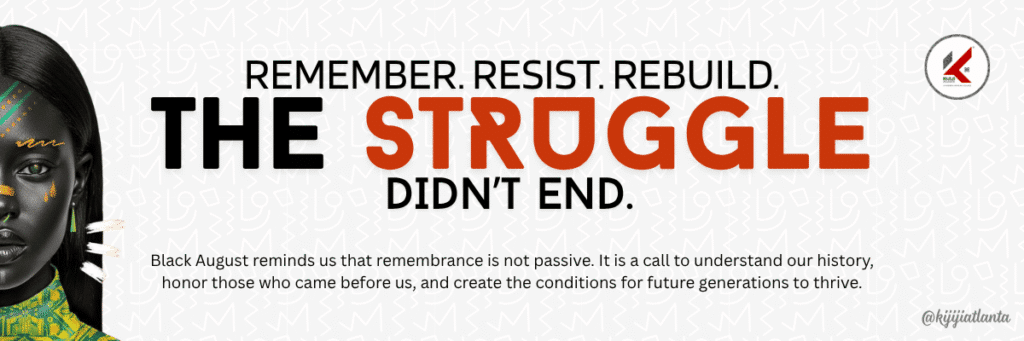
To keep the history alive, we need to relate it to the present. Black August did not remain inside the California prisons. Today, people observe it within communities through different activities. The activities include reading, community discussions, and cultural events. Political education, fasting, reflection and activism are also observed. The studies mainly focus on political prisoners. It also includes the history of slavery, the Civil Rights Movement and Black Power.
Some people connect the August commemoration to today’s policing, incarceration and racial inequality. They challenged the government or the system to make freedom real. Black August can create a bridge for younger generations. They can ask about today’s prison system. They could connect to history through learning about George Jackson or Nat Turner.
Why Should We Know About Black August?
We should know about Black August not because every person it remembers was perfect. They were not. We should not turn complicated human beings into saints. Similarly, we also should not erase their humanity because they were controversial. We should know about Black August because history is complicated.
We should know governments can protect citizens while committing serious injustices. Law enforcement can serve the public while responsible for misconduct or brutality. A country can speak about freedom while failing to provide equally to everyone. These contradictions are uncomfortable. But understanding them is part of becoming an honest reader of history.
A Bridge Between Generations
From the enslaved people who rose in Haiti in 1791 to Nat Turner’s rebellion in 1831. From the Civil Rights Movement to the Black Panthers. Black August connects generations through memories. George Jackson to modern conversations about racial justice. The people involved did not all believe the same things. They did not all use the same methods. And we do not have to agree with everything they did.
But we should try to understand the history without bias. The August commemoration asks us to remember those who struggled for freedom. It asks us to examine the systems they challenged. It asks us to think about justice—not only for powerful people, but for everyone. August reminds us to look beyond the resistance itself and ask what happened before it.
So, let’s look at history honestly. To remember the people who resisted. To acknowledge the complexity of their actions. To recognise the injustices that shaped their struggles. And, above all, to understand why they believed resistance was necessary.